

Yes, a photocopy can often be certified or notarised when the receiving authority accepts that form of verification. The original document is generally required so the copy can be compared with it. A photocopy should never be presented as a verified copy when the original has not been available for the required comparison.
Different authorities use terms such as “notarised copy,” “certified true copy,” “attested copy” or “self-attested copy.” These instructions are not automatically interchangeable, so confirm the exact requirement before arranging the service.
Quick Answer
- Carry the original document.
- Bring a clear photocopy of every required page.
- Include the reverse side if it contains information.
- Carry valid photo identity proof.
- Check who is authorised to certify the copy.
- Follow the receiving authority’s format and validity rules.
How A Notarised Photocopy Is Different
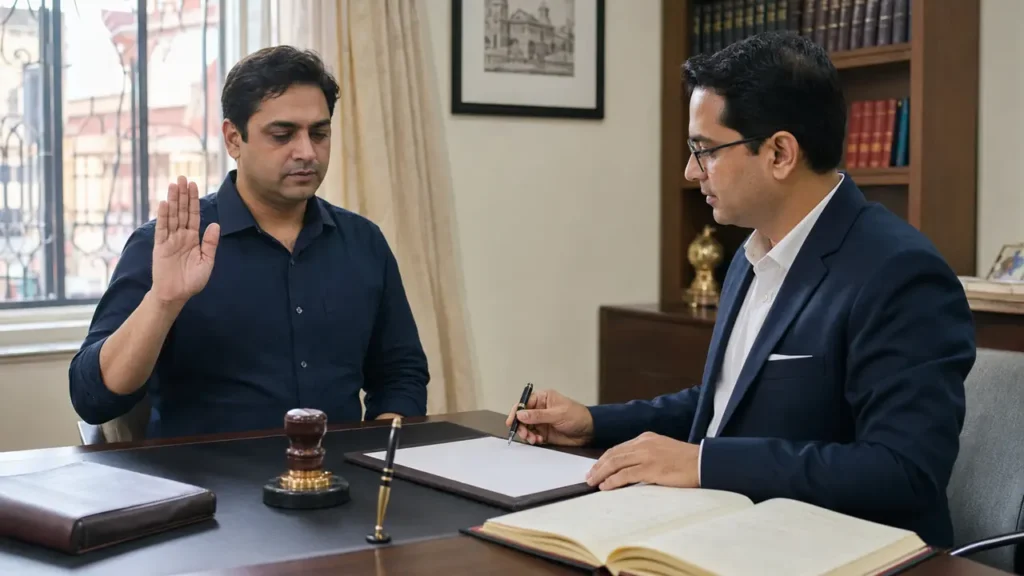
A plain photocopy only reproduces the document. A self-attested copy is signed by the document holder. A notarised or notarially certified copy involves a notary performing the applicable notarial act, commonly after comparing the copy with the original.
Section 8 of the Notaries Act, 1952 includes verifying, authenticating, certifying or attesting execution among a notary’s functions. The appropriate endorsement depends on the document and intended use.
Documents Commonly Copied For Verification
- Identity and address records
- Educational certificates and mark sheets
- Employment or experience records
- Property-related documents
- Company or business documents
- Banking or application records
- Passports and travel-related documents
Inclusion in this list does not mean that notarisation is accepted for every application. Banks, universities, employers, courts, government departments and overseas authorities may specify a different certifying authority.
Practical Photocopy Checklist
Use A Clear, Complete Copy
The page should be legible from edge to edge. Photographs, document numbers, QR codes, seals and signatures should not be cut off. Increase contrast only enough to improve readability; do not digitally alter the content.
Copy Both Sides When Necessary
If the reverse contains an address, conditions, endorsements or other information, copy it as well. Ask whether both sides should appear on one sheet or separate sheets.
Keep Multi-Page Records In Order
Copy every page requested by the receiving authority. Number the pages if appropriate and keep annexures with the main document. Do not mix pages from different versions.
Carry The Original
The original is generally needed for comparison. If the original is lost, damaged, held by another authority or available only in digital form, obtain instructions from the receiving authority before visiting. A printout of an online record may be treated differently from a photocopy of an original paper document.
What Cannot Be Fixed By Notarisation
Notarisation cannot cure an altered, incomplete or illegible source document. It also does not make a document genuine merely because a copy carries a seal. If the underlying record contains an error, obtain a correction from the issuing authority.
Similarly, notarisation does not replace registration, stamp duty, apostille, consular legalisation or verification by the original issuing institution when one of those steps is required.
Common Reasons A Copy May Be Rejected
- The original was not produced when required
- The copy is blurred, cropped or incomplete
- The name or date differs from the application
- The receiving authority requested a different attesting officer
- The certification is older than the authority’s permitted period
- The destination requires apostille, legalisation or direct institutional verification
- The document has visible alteration or overwriting
Before You Visit In Salt Lake, New Town Or Kolkata
- Ask whether the authority wants a notarised copy, certified copy or self-attested copy.
- Confirm how many sets are needed.
- Make clean copies and keep each set in page order.
- Carry the original and valid identity proof.
- Bring the authority’s checklist or email.
Maa Laxmi Quick Service provides Notary Service support in Salt Lake, New Town and Kolkata. Regulated notarial work is completed through qualified professionals. For a document-specific checklist, contact us before visiting.
Frequently Asked Questions
Can I Notarise A Photocopy Without The Original?
The original is generally required for comparison. If it is unavailable, ask the receiving authority what alternative evidence or certification it will accept.
Is A Self-Attested Copy The Same As A Notarised Copy?
No. A self-attested copy is signed by the holder. A notarised copy involves an applicable notarial act performed by a notary.
Can A Colour Scan Be Notarised?
A printout of a scan may not be treated in the same way as a photocopy compared with an original. Acceptance depends on the source document and the receiving authority.
How Many Photocopies Should I Carry?
Carry the number requested by the receiving authority and, when practical, one additional clean set for your own record.
Disclaimer: This article provides general information and is not legal advice. Certification requirements vary by authority and purpose. Regulated notarial and legal work is completed through qualified professionals.



 WhatsApp Us